
Liver Condition Guide
NASH Cirrhosis
Advanced liver scarring from NASH requires vigilant monitoring — your numbers tell the story.
NASH Cirrhosis occurs when years of NASH-driven inflammation cause extensive liver scarring (F4 fibrosis). About 20% of NASH patients eventually develop cirrhosis. Close monitoring of MELD scores, liver function, and complications is essential to guide treatment and determine transplant timing.

Understanding NASH Cirrhosis
NASH Cirrhosis is the end-stage of the NASH spectrum where chronic inflammation has caused irreversible scarring throughout the liver. The liver can still function in compensated cirrhosis, but decompensation — marked by ascites, variceal bleeding, or encephalopathy — signals the need for transplant evaluation. NASH is now the fastest-growing cause of cirrhosis and liver transplant worldwide.
Compensated vs. Decompensated NASH Cirrhosis
This distinction drives all treatment and monitoring decisions:
- •Compensated: Liver is scarred but still functioning. Many patients are asymptomatic. Median survival >12 years with proper management.
- •Decompensated: Liver function is failing. Marked by ascites, variceal bleeding, hepatic encephalopathy, or jaundice.
- •The transition from compensated to decompensated occurs at a rate of about 5–7% per year.
- •Once decompensated, median survival drops to ~2 years without transplant.
- •MELD score is the primary tool for tracking severity and transplant urgency.
Complications Requiring Monitoring
NASH cirrhosis patients need regular screening for these potentially life-threatening complications:
- •Ascites: Fluid accumulation in the abdomen. Managed with diuretics (spironolactone + furosemide) and sodium restriction.
- •Esophageal/gastric varices: Dilated veins from portal hypertension. Screening endoscopy every 1–2 years.
- •Hepatic encephalopathy: Confusion and cognitive changes from ammonia buildup. Treated with lactulose and rifaximin.
- •Hepatocellular carcinoma (HCC): Liver cancer screening with ultrasound + AFP every 6 months.
- •Spontaneous bacterial peritonitis (SBP): Infection of ascitic fluid. Requires prophylactic antibiotics in high-risk patients.
- •Hepatorenal syndrome: Kidney failure secondary to advanced liver disease.
MELD Score & Transplant Readiness
The MELD score is central to managing NASH cirrhosis:
- •MELD uses bilirubin, creatinine, and INR to predict 3-month mortality
- •MELD-Na adds sodium — low sodium worsens prognosis
- •MELD 3.0 includes sex and albumin for improved accuracy
- •MELD ≥ 15: Generally qualifies for transplant listing
- •MELD ≥ 25: High urgency — significant 3-month mortality risk
- •LiverTracker calculates all three MELD variants automatically from your labs
Management & Treatment
While cirrhosis itself is largely irreversible, progression can be slowed and complications managed:
- •Aggressive metabolic management: diabetes control, weight management, statin therapy
- •Complete alcohol avoidance — even small amounts accelerate decompensation
- •Low-sodium diet (< 2g/day) for ascites management
- •Regular paracentesis for refractory ascites
- •Beta-blockers (propranolol/carvedilol) for portal hypertension and variceal prophylaxis
- •Lactulose + rifaximin for hepatic encephalopathy prevention
- •HCC surveillance every 6 months (ultrasound + AFP)
- •Transplant evaluation when MELD indicates or first decompensation event
Key Labs to Track
MELD Score (Bilirubin, Creatinine, INR)
Primary transplant prioritization score. Track trends to anticipate listing timing.
Albumin
Low albumin indicates impaired liver synthetic function. Key for Child-Pugh and MELD 3.0.
Sodium
Hyponatremia is common in advanced cirrhosis and worsens MELD-Na score.
Platelet Count
Low platelets indicate portal hypertension severity.
INR / PT
Elevated INR reflects impaired clotting factor production by the liver.
Bilirubin
Rising bilirubin signals worsening liver function and possible decompensation.
AFP (Alpha-Fetoprotein)
HCC screening marker. Checked every 6 months.
Ammonia
Elevated ammonia correlates with hepatic encephalopathy risk.
Creatinine
Kidney function monitoring — hepatorenal syndrome is a serious complication.
How LiverTracker Helps
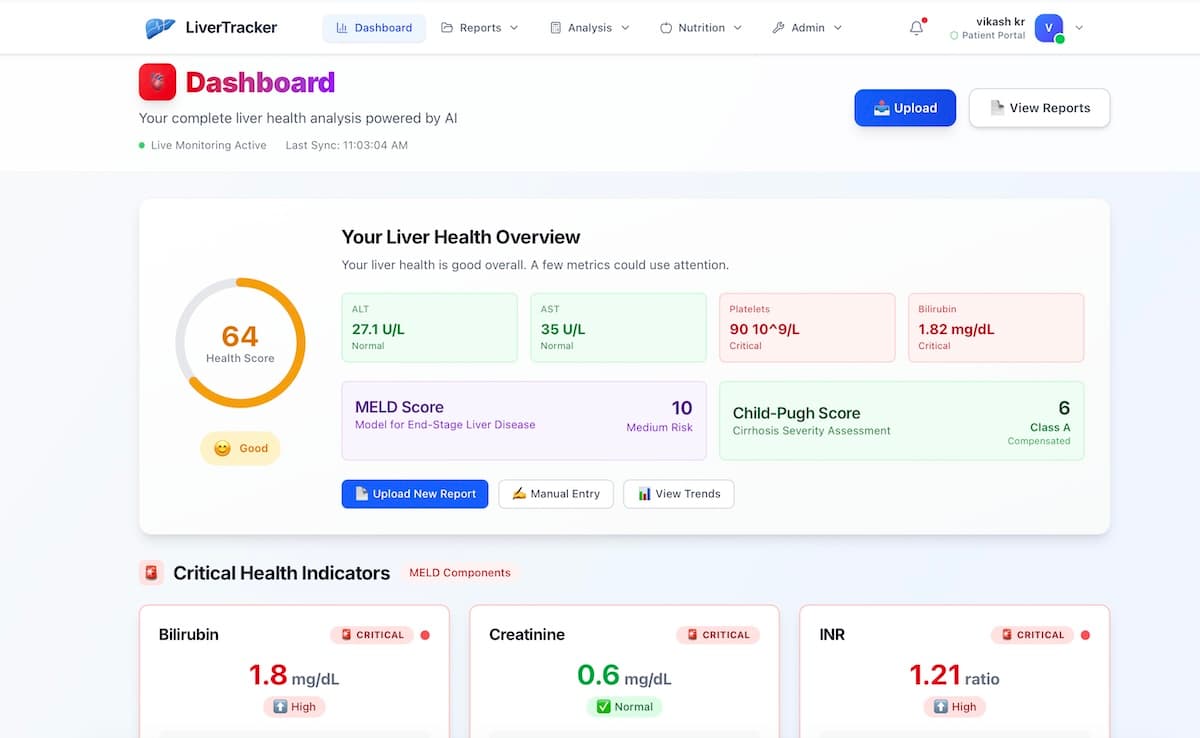
Automatic MELD, MELD-Na, and MELD 3.0 calculation from uploaded labs
Child-Pugh score tracking with compensated/decompensated status
Trend charts for bilirubin, albumin, INR, platelets, and sodium over time
AI-powered alerts when lab values suggest worsening liver function
Ascites and paracentesis tracking with fluid volume trends
Ammonia level monitoring for encephalopathy management
One-click report sharing with your transplant team
Imaging findings tracking for varices, ascites, and HCC surveillance
See Your Data Come to Life
Upload your lab reports and get instant AI-powered insights, trend charts, and health scores.
Frequently Asked Questions
Can NASH cirrhosis be reversed?
Established cirrhosis (F4) is generally irreversible, but progression can be halted and some fibrosis regression is possible with aggressive metabolic management. The key is preventing decompensation and managing complications.
When should I be evaluated for transplant?
Transplant evaluation typically begins when MELD reaches 15 or at the first decompensation event (ascites, variceal bleed, encephalopathy). Your hepatologist will guide the timing based on your specific situation.
How is NASH cirrhosis different from other types of cirrhosis?
The liver damage is the same (F4 fibrosis), but NASH cirrhosis patients often have metabolic comorbidities — diabetes, obesity, cardiovascular disease — that complicate both management and transplant candidacy. Post-transplant, NASH can recur in the new liver.
What is the life expectancy with NASH cirrhosis?
Compensated NASH cirrhosis has a median survival of 12+ years with proper management. Once decompensation occurs, survival drops to about 2 years without transplant. Regular monitoring and early intervention significantly improve outcomes.
Related Conditions
Take Control of Your Liver Health
Upload your lab reports, track your progress, and get AI-powered insights — all for free.
Get Started FreeMedical Disclaimer: This page is for educational purposes only and does not constitute medical advice. Always consult your hepatologist or primary care physician for diagnosis and treatment decisions.